
Stuck on today’s Connections puzzle? You’re not alone. Many players search for connections forbes daily puzzle hints answers when a tricky group refuses to click. A small hint can be enough to get your brain moving without ruining the fun. Whether you’re solving over breakfast or squeezing in a quick game during a break, the right clue can make all the difference.
You may also come across completely different searches while browsing online. For example, people ask, “do the driving modes in cadillac lyriq offer different ranges or battery usages?” Others look for simplifydiggs com, wondering, “I am a college student. Are la roche-posay products better for acne-prone skin than neutrogena?”, or search for a tiktok viewer. These topics have little to do with Connections, but they show how varied online searches can be.
Here, the focus stays on the daily puzzle. You’ll find useful hints, possible answers, and simple solving tips without unnecessary confusion. We’ll also explain common traps and tricky word connections. If you’ve seen an uploadblog review or similar search results while looking for answers, don’t let them distract you. Let’s get back to the puzzle.
What Are Forbes Connections?
“Connections Forbes” generally refers to Forbes’ coverage of the NYT Connections puzzle. It isn’t the name of a separate game. Instead, the phrase describes daily Forbes articles that help readers work through the current Connections grid.
These guides typically move from general information toward more revealing clues. Players may find the puzzle words, category hints, individual answers, and complete group explanations in the same article.
How the NYT Connections Puzzle Works
NYT Connections gives you a board containing 16 words, phrases, symbols, or other entries. Your task is to arrange them into four groups of four based on a shared connection.
The challenge isn’t simply finding relationships. Several words may appear to belong together when they actually serve as distractions. You have a limited number of incorrect guesses, so careful reasoning matters.
Why Players Search for “Forbes NYT Connections Hint Today”
Many players don’t want the answer immediately. They simply need a nudge when one category refuses to make sense. That’s why searches such as “Forbes NYT Connections hint today” are common.
A good hint can preserve the solving experience. You might learn that a category involves a type of sport, phrase, object, or cultural reference without being told every word.
Step 1: Check the Puzzle Difficulty
Start by considering how challenging the grid appears. Some puzzles have obvious groups, while others rely heavily on wordplay, unusual references, or misleading associations.
Knowing that a puzzle may be difficult can also change your approach. Instead of rushing into a guess, slow down and look for stronger evidence.
Step 2: Use Category Hints
Category hints are usually the best middle ground between solving alone and reading the answers. They tell you what kind of relationship to search for without necessarily revealing the complete group.
For example, a hint might suggest a connection involving music, sports, food, names, or common phrases. Once you know the general direction, return to the grid and test your ideas.
Step 3: Reveal the Full Answers
Complete answers should usually come last. If you’ve already tried several approaches, seeing the solution can show exactly where your reasoning went off track.
Don’t stop at simply reading the four words. Look at why they belong together and why another tempting word was excluded. That’s where the real lesson is.
Why Forbes Connections Today Gets So Much Attention
Daily Connections puzzles naturally encourage repeat searches. Players who solve the game regularly may return whenever a particular grid becomes difficult.
Forbes also presents puzzle assistance in a convenient format. Instead of searching separately for clues, categories, and solutions, readers can often find several levels of help in one place.
How Forbes Connections Hints Are Structured
A typical Connections guide gradually increases the amount of information it reveals. The page may begin with an explanation of the game before moving into the day’s word list and hints.
After that, readers can usually find category-level clues, representative answers, and the complete groups. This structure works well because you can stop reading as soon as you have enough information to continue.
How to Use Connections Forbes Hints Without Spoiling the Puzzle
The smartest way to use a Connections hint Forbes article is to treat it like a safety net. Try the puzzle first. When you’re stuck, use the smallest clue that could help.
For instance, if three words seem related, don’t immediately reveal the fourth. Check a broad category clue and see whether it points you in the right direction. You may still solve the group yourself.
Try Solving NYT Connections on Your Own First
Give yourself a few minutes before searching for help. Scan all 16 entries and mark the words that seem especially unusual, specific, or familiar.
Don’t lock in a group just because four words have something in common. Connections often uses broad relationships as red herrings. A correct category usually has a more precise connection.
Reveal One Hint at a Time
Progressive hinting keeps the game enjoyable. Begin with a category clue, then move to a more specific hint only if necessary.
This approach also helps you measure your improvement. If you can solve a category after one clue today but needed the complete answer last week, you’re making progress.
Consider Words With Multiple Meanings
A single word can behave in several ways. It might be a common noun in one category but part of a title, name, phrase, or technical term in another.
When you’re stuck, ask yourself whether you’ve been thinking about the word too narrowly. Connections often rewards players who can switch between different meanings quickly.
Common Themes in Forbes Connections Clues
Connections categories can cover an impressive range of subjects. Possible themes include sports terms, music references, objects, phrases, names, entertainment, food, and word patterns.
You don’t need expert knowledge in every subject. Often, the other entries provide enough context to help you recognize an unfamiliar category.
Tips for Solving NYT Connections Faster
Getting faster isn’t about guessing quickly. It’s about recognizing patterns before you waste guesses.
A consistent process can help. Scan the entire board, identify strong relationships, question weak ones, and save ambiguous entries until later.
1. Start With Obvious Groups
Look for four entries with an unusually strong connection. Clear synonyms, familiar phrases, or recognizable categories often provide the best starting point.
Once you remove a confirmed group, the remaining board becomes easier to analyze. Four fewer words can completely change what you see.
2. Ignore Misleading Matches
A relationship can be real without being the intended answer. That’s one of the central tricks of Connections.
If four words seem connected only in a broad sense, pause. Look for a more specific relationship that explains the entries more cleanly.
3. Examine Every Word Closely
Read the words rather than simply glancing at them. Look at spelling, capitalization, endings, prefixes, and possible phrase combinations.
Sometimes a basic word becomes important only when paired with another word. That small detail can unlock an otherwise difficult category.
4. Separate Names and Proper Nouns
Some entries may represent people, places, brands, fictional characters, songs, or titles. Treating every word as ordinary vocabulary can hide these connections.
If several entries look like names, mentally place them in a separate group. Then see whether the remaining words form a stronger category.
5. Set Aside the Hardest Words
You don’t have to solve every word at once. If one entry seems impossible, leave it alone temporarily.
After solving one or two easier groups, that difficult word may suddenly have only one logical home. Sometimes the best way to solve a word is to stop looking at it.
Common NYT Connections Mistakes to Avoid
One common mistake is confusing association with category. Four words may all remind you of summer, for example, but that doesn’t mean they belong together.
Another mistake is spending too many guesses on a weak theory. If a category requires you to explain away one questionable word, step back and search for a cleaner pattern.
Why Daily Connections Hints Continue Growing in Popularity
Daily puzzle hints fit naturally into the way people play word games. Players often want quick assistance while still enjoying the challenge.
Hints are particularly useful for people who care about maintaining a daily routine. A small clue can keep a difficult puzzle from becoming frustrating without removing the entire challenge.
Can Forbes Connections Hints Help Improve Puzzle-Solving Skills?
They can, especially when you study the reasoning behind each answer. Simply copying a solution doesn’t teach much. Understanding why a category works is far more useful.
After each puzzle, think about the connection you missed. Was it a multiple meaning? A proper noun? A phrase? A cultural reference? Identifying the pattern helps you recognize it next time.
Alternatives to Forbes Connections
Forbes is one source of puzzle guidance, but it isn’t the only option. The official NYT Games experience is the place to play the puzzle itself, while other puzzle resources may offer different approaches to hints and explanations.
Different sources can also vary in spoiler levels. If you prefer solving independently, look for resources that separate broad clues from complete answers.
How to Find NYT Connections Hints Without Seeing Spoilers
Your search wording matters. A query asking for “NYT Connections hints today” is generally less revealing than one asking directly for all answers.
You can also stop reading once you’ve reached the hint section. Don’t scroll farther unless you’re ready to see categories or complete solutions.
How to Solve NYT Connections Without Giving Away the Answers
Start with the strongest relationships you can identify. Then test each group against every remaining word before submitting it.
If you’re unsure, don’t force the category. Write down your possible groups mentally and compare them. Often, solving one group elsewhere will eliminate the uncertainty.
Use the Four-Group Pattern to Narrow Your Choices
Remember the basic structure: four groups, four entries per group. Every confirmed group reduces the number of possibilities on the board.
This is especially helpful when two categories overlap. Solving one clean group can reveal that a tempting word was actually intended for another category.
NYT Connections Hints and Answers for Today
Players searching for NYT Connections hints today usually want one thing: enough help to finish the current puzzle.
The best approach is to begin with a hint and only move toward the answers if necessary. That keeps the daily puzzle challenging while giving you an escape route when you’re genuinely stuck.
How to Play NYT Connections
The basic idea is simple. You receive 16 entries and need to divide them into four groups of four.
Each group shares a specific relationship. Select four entries and submit them. Correct groups disappear from the board, while incorrect selections cost you one of your available mistakes.
Today’s NYT Connections Word List
The daily word list contains all 16 entries used in the current puzzle. Reading the complete list before making a guess is useful because it lets you compare possible relationships across the entire board.
Don’t focus only on the first four words that catch your attention. A better category may be hiding among entries you initially overlooked.
Today’s NYT Connections Hints
Hints should point you toward a category without completely solving it. That’s why they’re valuable for players who want assistance while preserving some of the challenge.
Use the first hint as a direction rather than a command. Once you understand the general theme, return to the grid and test the words yourself.
One Answer for Each NYT Connections Group
Sometimes one representative answer is enough to unlock a category. It gives you a starting point without immediately revealing the entire group.
If you use this kind of clue, try to identify the other three entries independently. You’ll get more value from the puzzle than if you simply copy all four.
Today’s NYT Connections Categories
The four categories explain the logic behind the daily grid. They can be straightforward, but they may also rely on wordplay, cultural references, phrases, or less obvious meanings.
When reading the categories, ask why each word belongs. The explanation matters just as much as the category label.
Today’s NYT Connections Answers
The complete answers provide the final solution for the day’s puzzle. They’re useful when you’ve exhausted your own ideas or want to check a completed attempt.
If you’re using answers for practice, spend a moment reviewing the rejected possibilities too. Those misleading words often reveal how the puzzle was designed.
Get Custom Puzzle Alerts and Daily Updates
Daily puzzle players often prefer a consistent routine. Alerts and updates can make it easier to remember the day’s puzzle and return when new hints become available.
However, don’t let notifications turn solving into a race. The goal is to enjoy the puzzle and gradually become better at spotting word patterns.
Today’s NYT Connections Answers Explained
A list of answers tells you what worked. An explanation tells you why it worked.
That’s an important distinction. When you review a completed puzzle, focus on the exact relationship shared by the four entries and the reason similar-looking words didn’t belong.
Connections – Yellow Group
The yellow group is generally presented as the most approachable category. It often has a relationship that can be recognized relatively quickly.
That doesn’t mean it’s always obvious. Even an apparently simple category can contain a word designed to pull you toward a different group.
Connections – Green Group
The green group typically requires a little more attention. Its entries may share a phrase, concept, or relationship that isn’t immediately visible.
When reviewing this category, consider whether the connection depends on how the words are used rather than their basic definitions.
Connections – Blue Group
Blue categories can involve more specialized knowledge or a less direct relationship. They may draw from entertainment, sports, culture, or another specific subject.
If you miss a blue group, don’t assume you lack the necessary knowledge. Sometimes the challenge comes from how the category is worded.
Connections – Purple Group
Purple is often where the puzzle becomes most playful. Wordplay, unusual meanings, phrase structures, and subtle relationships can make this group harder to spot.
Look beyond the most common meaning of each word. A phrase, title, abbreviation, or secondary definition may be the key.
Connections Red Herrings Explained
Red herrings are words that appear to belong to a category but actually fit somewhere else. They’re one of the main reasons Connections can feel harder than a normal word-association game.
For example, three entries might clearly fit a theme while a fourth seems close enough. Before submitting, ask whether another word creates a tighter and more deliberate category.
NYT Connections Clues, Hints, and Answers for September 24, 2026
For a date-specific puzzle, always make sure you’re reading the guide for the correct day. Connections changes every day, so yesterday’s answers won’t help with today’s grid.
Date-specific searches are particularly useful when you’re checking a solution after playing. They help you avoid accidentally reading an unrelated puzzle’s clues.
Practice NYT Connections With a Puzzle Board
Practice can help you develop pattern recognition without the pressure of a daily puzzle. A practice board lets you experiment with relationships and learn how red herrings work.
Try creating groups before checking whether they’re correct. The exercise is less about speed and more about learning how to distinguish a precise category from a loose association.
How the Practice Board Works
A practice board typically gives you a collection of entries that can be divided into groups. You select possible sets and evaluate whether the relationship is specific enough.
The more you practice, the easier it becomes to recognize common patterns. You’ll also become more comfortable abandoning a weak theory before it costs a guess.
NYT Connections Reveal Assistant
A reveal tool can be useful when you’re completely stuck. However, it’s best used after you’ve made a genuine attempt.
If you reveal everything immediately, you lose the chance to practice. Instead, use assistance in stages whenever possible, beginning with a category clue and progressing only when necessary.
Tricky Words and Common Connections
Some words are difficult because they’re extremely flexible. They can fit several themes, form multiple phrases, or represent something beyond their everyday definition.
Keep an eye out for:
- Words with several definitions
- Names that also have ordinary meanings
- Words used in familiar phrases
- Abbreviations
- Titles and proper nouns
- Words that can change meaning when paired with another entry
Daily Puzzle Solvers, Hints, and Answers
Puzzle solvers can be useful when you need help across several daily games. However, each tool works best when you understand what kind of assistance you actually need.
If you’re only missing one category, a targeted hint may be better than a complete solver. The less information you reveal, the more of the puzzle remains yours to solve.
Wordle Solver
Wordle focuses on identifying a single hidden word through letter-based clues. Its solving process differs from Connections, which depends on relationships between multiple entries.
Still, both games reward careful observation and strategic elimination.
NYT Pips Solver
Pips is a different type of logic puzzle. Instead of grouping words, it asks players to reason through domino-like relationships.
Its presence alongside Connections reflects the wider collection of daily games that attract regular puzzle players.
Spelling Bee Solver
Spelling Bee centers on building words from a specific group of letters. Unlike Connections, the challenge revolves around vocabulary construction rather than category matching.
The two games can complement each other by exercising different language skills.
Letter Boxed Solver
Letter Boxed asks players to create words while moving between groups of letters. It rewards vocabulary knowledge and planning.
Connections players may enjoy it because both games encourage you to look beyond the most obvious word possibilities.
NYT Daily Hints
Daily hints are useful when you want a nudge without seeing an entire solution. They can also help players maintain a routine when a particular puzzle proves unusually difficult.
The key is to use the hint as a prompt for thinking rather than a replacement for thinking.
NYT Mini Hints
The Mini offers a quicker daily puzzle experience. Hints can be useful when you’re trying to keep your solving streak moving without spending too much time on one clue.
Short puzzles still benefit from careful reading. A tiny detail can make the difference between a correct and incorrect answer.
Strands Hints
Strands uses a theme-based word search format. Its mechanics differ from Connections, but both games require players to identify relationships between words.
Players who enjoy one often appreciate the other because both reward pattern recognition.
Word Grid Solver
Word-grid tools can help players explore possible combinations when they feel stuck. However, use them carefully if your goal is to improve independently.
The best practice is to attempt the puzzle first, then use a solver to understand what you missed.
How to Solve NYT Connections: Strategies and Hints
The most reliable Connections strategy is simple: don’t rush. Look across the entire board before committing to a category.
Search for strong relationships first, then use elimination to solve the harder groups. With practice, you’ll start recognizing familiar puzzle structures.
What Is NYT Connections?
NYT Connections is a daily word-association game built around four groups of four entries. The entries may look unrelated at first, but each group has a shared connection.
The difficulty comes from overlap. Several words may appear to fit together, while only one arrangement matches the puzzle’s intended categories.
Best Tips and Strategies for Solving NYT Connections
A good solving routine combines observation, elimination, and patience. You don’t need to understand all 16 words immediately.
Start with your strongest idea, test it carefully, and let confirmed groups reduce the board. If a theory becomes increasingly complicated, it’s often worth reconsidering it.
1. Find the Most Obvious Group First
Start with the category that has the clearest relationship. This gives you a reliable foothold.
After removing those four words, reconsider the remaining entries from scratch. Don’t assume your original interpretation still applies.
2. Pay Attention to Word Placement
The visual position of a word shouldn’t determine your answer. However, scanning the board systematically can help you avoid overlooking an entry.
Read horizontally, vertically, and randomly. A fresh visual arrangement can sometimes expose a connection you missed.
3. Look for Connections Across Different Topics
Categories aren’t limited to everyday vocabulary. They can involve music, sports, entertainment, geography, phrases, objects, or names.
If an obvious group doesn’t appear, broaden the kinds of relationships you’re considering.
4. Identify Potential Red Herrings
Whenever four words seem connected, look for an alternative explanation. Ask whether one of those words might fit another category more precisely.
This simple check can prevent many unnecessary mistakes.
5. Double-Check Before Submitting
Before clicking submit, say the category to yourself. Then explain why each of the four words belongs.
If you can’t clearly explain one entry, you may have found a red herring rather than the intended group.
6. Protect Your Limited Mistakes
Every incorrect guess gives you less room to experiment. Treat each submission as a decision, not a casual test.
If you’re uncertain, keep analyzing. Waiting for stronger evidence is often better than gambling on a weak connection.
7. Use Unambiguous Words as Anchors
Some entries have only one obvious interpretation. These are valuable anchors.
Build around them first. Once an anchor points toward a category, search the remaining words for entries that match the same precise relationship.
8. Consider Alternative Word Meanings
When the puzzle gets difficult, revisit words you’ve already dismissed. Think about secondary definitions, phrases, abbreviations, and proper nouns.
A word that seems useless under one interpretation may become essential under another.
9. Use “One Away” Feedback Carefully
If the game indicates that you’re close, don’t simply swap words at random. Treat that feedback as evidence.
Reconsider the entire category and ask which entry might belong elsewhere. One small change can reveal the intended grouping.
10. Write Down Possible Groups
If you’re solving away from the screen or want a clearer mental picture, write down your candidate categories.
Seeing several possible groups at once makes overlaps easier to identify. It also helps prevent you from forgetting a connection you noticed earlier.
How NYT Connections Difficulty Levels Work
Connections difficulty isn’t determined only by how obscure the words are. A familiar word can be difficult when it has several possible meanings.
A puzzle becomes challenging when multiple entries support plausible interpretations. The strongest solvers learn to distinguish between a possible connection and the intended one.
What Makes a Connections Category Difficult?
Difficult categories often rely on subtle relationships. They may use wordplay, uncommon references, phrases, or meanings that aren’t the first thing you associate with an entry.
Purple categories can be especially demanding because they often reward lateral thinking. Still, any color can become difficult if the words overlap heavily.
Mistakes That Can Make NYT Connections Harder
Trying to solve the entire board simultaneously is exhausting. Focus on one strong relationship at a time.
Another mistake is becoming attached to a theory. If a category requires too many explanations, let it go. Good Connections groups usually become clearer once you see the intended relationship.
Extra Tips for Becoming Faster at NYT Connections
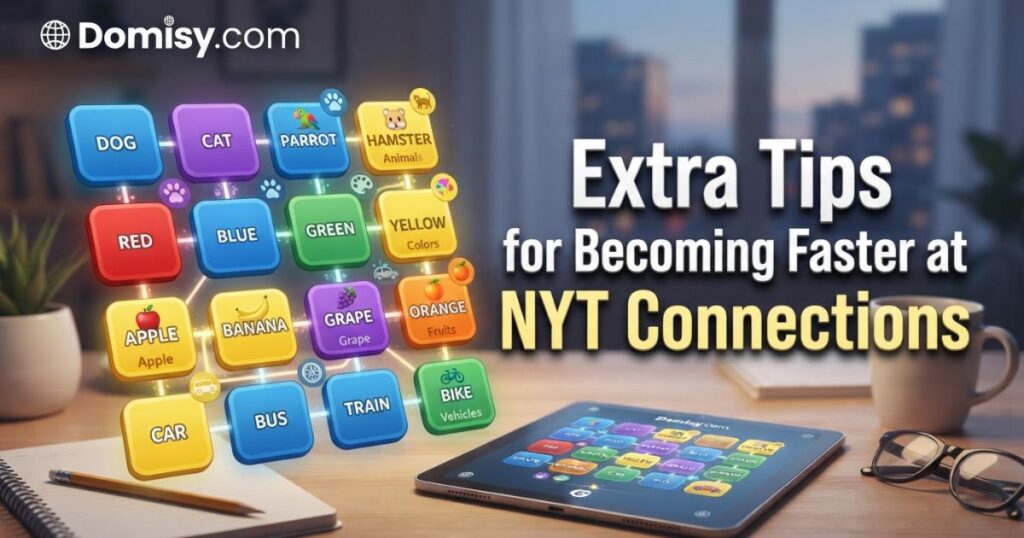
Practice recognizing category types instead of memorizing individual answers. Learn to notice phrase patterns, synonyms, names, compound words, and specialized terminology.
It also helps to review puzzles you found difficult. Ask what fooled you. That reflection turns a frustrating game into useful practice.
FAQ’s
Where Can I Find NYT Connections Hints Today?
Forbes Connections coverage can provide daily clues, category hints, and answers, depending on the current puzzle and article.
How Can I Get a Hint Without Seeing the Answer?
Start with a broad category hint, then reveal more information only if you’re still stuck.
Are Forbes Connections Hints the Same as NYT Answers?
Forbes provides coverage of the NYT Connections puzzle; its hints and explanations refer to the same daily game.
What Is the Best Way to Use Connections Hints?
Try solving independently first, then use the least revealing clue that helps you continue.
Why Does Connections Use Red Herrings?
Red herrings create extra plausible relationships, forcing players to identify the intended category rather than any possible association.
Can Connections Hints Improve My Solving Skills?
Yes. Reviewing why a category works can help you recognize similar word patterns and relationships in future puzzles.
What Should I Do When Four Words Seem to Match?
Check whether the relationship is precise and intentional before submitting, because another word may create a stronger category.
Conclusion
In the end, Connections are most enjoyable when you give yourself time to think. If a category feels impossible, a small clue can point you in the right direction without spoiling everything. That’s why searches for connections Forbes daily puzzle hints answers remain useful for daily players who want a little extra help.
You may also encounter unrelated searches online, such as “do the driving modes in cadillac lyriq offer different ranges or battery usages?”, simplifydiggs com, or “I am a college student. Are la Roche-posay products better for acne-prone skin than neutrogena?” You might even see terms like tiktok viewer or uploadblog review while browsing.
However, the goal here is simple: help you enjoy Connections and solve with more confidence. Start with the obvious groups, question misleading matches, and use hints only when needed. Over time, you’ll spot patterns faster and rely less on complete answers. Most importantly, keep the puzzle fun. Even a tough grid can feel rewarding once the final connection clicks.