
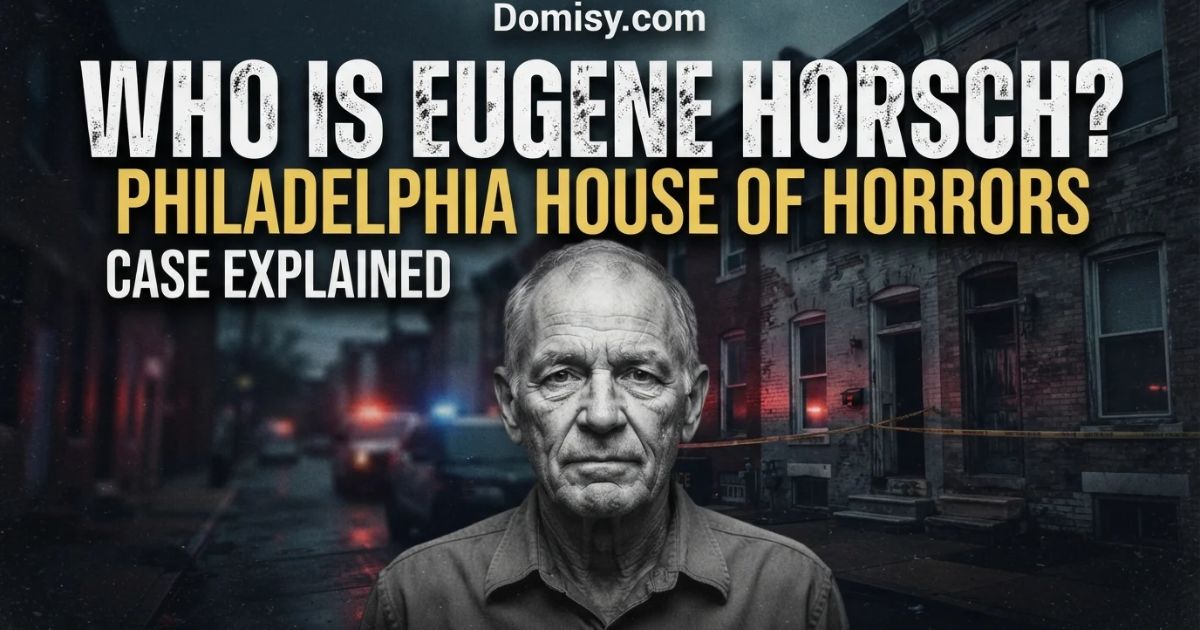
Eugene Horsch’s story has drawn attention because of the disturbing questions surrounding his name. If you’re searching for an eugene horsch biography, you’ll likely find more questions than simple answers. His background, family connections, and reported legal troubles have all become part of the discussion. But separating confirmed details from claims matters.
The Eugene Horsch biography appears in reports connected to a troubling Philadelphia case. Some references also use variations such as horsch and horsh, which can make online searches confusing. Understanding these spelling differences can help you follow the available information without mixing people or records together.
This article brings the key details into one clear overview. You’ll learn about Eugene Horsch’s background, reported criminal history, family ties, and the investigation surrounding him. Where information remains uncertain, we’ll point that out rather than present speculation as fact.
Who Is Eugene Horsch? Background and Early Life
Eugene Albert Horsch is a Philadelphia man whose name became widely known after investigators began examining his former home in Olney. He was born in 1981 in New Zealand to Raymond “R.C.” Horsch and Anna Ferkuniak, according to reporting cited in the original investigation. His childhood was unusual from the beginning because his father had been living under aliases while avoiding U.S. authorities.
After the family returned to the United States, Eugene’s mother died from an accidental overdose in 1989. Eugene was seven years old at the time. He was subsequently raised by his father, Raymond, whose own criminal history and unconventional career later became an important part of Eugene’s family background.
Eugene attended Central Bucks West High School and was described by school officials as a strong student. He later attended Drexel University between 1999 and 2003, although available reporting does not establish that he completed a degree.
That early academic path contrasts sharply with his later legal history. His adult life included multiple arrests and prison sentences, eventually bringing him back into the spotlight after the investigation at 417 West Chew Avenue.
Eugene Horsch’s Arrest and the Philadelphia Investigation
The current investigation began with an arrest that initially had nothing publicly to do with missing women. On June 19, 2026, Horsch was arrested near Independence National Historical Park after a park ranger encountered his vehicle. A woman in the car reportedly had identification showing her photograph but another woman’s name. That woman was later identified as Blair Tonzelli, who had been reported missing.
Police reported finding firearms, drugs, knives, and other items inside the vehicle. Investigators also said Horsch possessed false federal law-enforcement credentials. Federal charges later included possession of a firearm by a felon and possession of an unlawfully produced document and authentication feature.
The arrest prompted investigators to examine Horsch’s home on West Chew Avenue. What they found there expanded the investigation dramatically.
Authorities reported discovering chemicals, drug-related materials, firearms, and an extensive collection of digital files. The home also contained unusual equipment in the basement, including a large drum connected to piping. Police and federal investigators later examined portions of the property and excavated pipes as they searched for possible evidence.
Importantly, Horsch’s arrest does not mean he has been charged with killing or harming any of the women under investigation. Those allegations remain separate from the federal weapons and drug case.
A Life Shaped by His Father, R.C. Horsch
Raymond “R.C.” Horsch is central to understanding Eugene Horsch’s family history. Raymond was a photographer, filmmaker, and author whose work frequently involved explicit sexual and violent themes. His criminal record also included drug and counterfeiting convictions.
Raymond lived at the West Chew Avenue property with Eugene for years. According to reporting, ownership of the house eventually passed to Eugene after Raymond transferred it to his son in 2007 for $1. Raymond died in 2025 at age 82.
The father’s background matters because investigators are examining activities that took place at the property over a long period. Police have specifically said they are looking at the home’s history rather than assuming every piece of evidence relates to Eugene.
That distinction is especially important when discussing the digital archive. Authorities have said some recordings may have been staged as part of Raymond’s filmmaking. Other material, however, appeared serious enough to prompt medical examiner review and a broader homicide investigation.
How Eugene Horsch’s Family History Connects to the Case
Eugene’s connection to Raymond is more than a simple father-son relationship. He grew up largely under his father’s care and later shared the same Philadelphia property.
Another missing woman, Amy McHale, was Raymond’s former wife. McHale disappeared in 2016, and investigators have revisited her case while examining the West Chew Avenue house. Authorities are also examining the disappearance of Blair Tonzelli, whose name became part of the investigation after the June traffic stop.
Still, being connected to a missing person’s case doesn’t establish criminal responsibility. Investigators must determine what happened to each woman and whether the evidence supports any criminal charges.
Eugene Horsch’s Criminal History and Legal Record
Eugene Horsch had a substantial criminal record before the current investigation. His earlier cases involved driving offenses, drugs, assault allegations, and other criminal matters.
One major case stemmed from a 2003 drunk-driving crash. Another driver suffered catastrophic brain injuries and remained in a vegetative state for years before dying. Horsch pleaded guilty to DUI and aggravated assault in 2004 and received a prison sentence, according to reporting based on court records.
His later legal history included drug-related arrests. In 2013, authorities discovered a large marijuana operation at the West Chew Avenue property, leading to a four-to-eight-year prison sentence for drug trafficking. He was also arrested in 2025 on marijuana and amphetamine possession charges and later received probation.
In March 2026, police accused Horsch of stabbing a man during a dispute in Philadelphia. Prosecutors later withdrew that case after a witness failed to appear.
These incidents form part of Eugene Horsch’s documented criminal history, but they shouldn’t automatically be connected to the missing-women investigation. None of those earlier cases established that he was responsible for the women whose disappearances are now being examined.
The Women Featured in the Horsch Videos
One of the most disturbing parts of the investigation involves the digital files recovered from the West Chew Avenue property.
By September 2026, Philadelphia police said investigators had identified 58 people appearing in the recovered material. Some had been located and interviewed, while others were still scheduled for interviews. Authorities also said several women appeared to be dead or unconscious in portions of the footage.
Police eventually said five women appeared to be deceased in the material. Two women had previously been publicly identified as Gabrielle Amarando and Maribel Fresses. Investigators later identified Nicole Amanda Fusaro among the women connected to the material, while another woman remained unidentified.
The medical examiner’s role is important here. Officials have said that, if the images are genuine and haven’t been manipulated, the people shown may be deceased. But photographs and videos alone cannot answer every question surrounding a death.
No human remains connected to the five women had been recovered in the reporting available by early October 2026. Without remains, investigators may have limited ability to establish an exact cause or manner of death.
What Investigators Have Revealed So Far
Authorities have been careful about what they can confirm. Investigators reportedly reviewed only part of the enormous digital collection while working with the FBI and other agencies.
Some footage appears to show violence against women. Police have also warned that Raymond Horsch produced staged films, meaning investigators must distinguish fictional or acted scenes from genuine events.
That distinction makes the investigation unusually complicated. A disturbing video may look convincing while still requiring independent evidence before authorities can determine what actually happened.
Investigators are therefore comparing the digital material with missing-person records, interviews, forensic evidence, property searches, and other records. Their goal is to establish identities and determine whether the events depicted were real.
The Basement at 417 West Chew

The basement of 417 West Chew Avenue became an important part of the investigation after police discovered chemicals and unusual equipment there.
Authorities reported finding a large drum, pipes connected to water lines, drug-related materials, and other substances. Investigators later excavated portions of the property’s pipes so forensic teams could examine them for possible evidence.
Police also reported finding items associated with missing-person investigations inside the house. However, reports about the property have sometimes spread faster than verified evidence. For example, early rumors about human remains were not supported by authorities at the time.
This is why the basement should be viewed as an area of investigation rather than proof of a specific crime. Detectives still need forensic results to determine what the equipment and materials were used for.
The Trade Eugene Horsch Inherited From His Father
Raymond Horsch’s career involved photography and filmmaking, including material featuring sexual and violent themes. That background has become relevant because investigators found a huge digital archive at the property.
However, describing Eugene as inheriting his father’s filmmaking career would go beyond what the available evidence establishes. There is a difference between living with someone who created disturbing material and participating in that person’s work.
Police have also cautioned that some videos recovered from the home may have been staged. This creates an important challenge for investigators: they must determine which recordings represent fictional performances and which may document real events.
For readers researching the Eugene Horsch biography, this distinction is crucial. His father’s history helps explain why investigators are examining the archive so closely, but it doesn’t by itself establish Eugene’s involvement in the material.
The Alleged Confession and Last Forgery
Reports about writings found at the property have added another layer to the case. Investigators reportedly recovered an unsigned handwritten document containing references to violence and serial-killer themes. Authorities have considered whether such writings were fiction, a screenplay, or something connected to real events.
That uncertainty matters. A person’s fictional writing cannot automatically be treated as a confession, even when it contains disturbing details.
The same principle applies to any alleged forgery or confession associated with the investigation. Investigators would need to establish who created a document, when it was written, and whether its contents correspond with independently verified evidence.
Who Wrote the Confession Linked to Eugene Horsch?
The available reporting does not establish that Eugene Horsch wrote a genuine confession admitting responsibility for the missing women.
Documents or writings found during an investigation can have several possible explanations. They might be fictional work, personal writing, copied material, or evidence of something more serious. Determining authorship requires forensic examination and supporting evidence.
For that reason, readers should be cautious with online claims that describe an alleged document as a confirmed confession. The investigation has not publicly established that conclusion.
Why No One Has Been Charged in the Case Yet
Eugene Horsch has not been charged with crimes involving the missing women. His federal case concerns weapons and drug-related offenses, while authorities continue examining the separate missing-person investigation.
There are several reasons investigators may delay charges in a complicated case. They may need to confirm identities, authenticate digital evidence, determine whether deaths actually occurred, and establish who was responsible.
A suspected crime and a prosecutable case aren’t the same thing. Investigators need evidence strong enough to support specific allegations in court.
What Happened at the Philadelphia House of Horrors?
The phrase “Philadelphia House of Horrors” has been used by media outlets to describe the West Chew Avenue property because of the disturbing evidence recovered there. However, the nickname shouldn’t be confused with a legal finding.
The house became the focus of the investigation after Horsch’s June 2026 arrest. Police subsequently searched the property and discovered an unusually large digital archive, chemicals, weapons, drugs, and other evidence. The investigation then expanded to include multiple missing women.
By September, police said at least seven women had some connection to the property or investigation, with five appearing to be deceased in recovered images or videos. Investigators were still working to determine exactly what happened to them.
The case remains unusual because the evidence mixes potentially real events with material created by a filmmaker known for staging violent scenes.
Eugene Horsch Case: Evidence, Investigation and Unanswered Questions
The investigation involves several different evidence categories rather than one single piece of proof.
| Evidence or lead | What authorities are examining |
| Digital photos and videos | Whether people shown in the material are alive, deceased, or part of staged scenes |
| Missing-person records | Whether missing women can be connected to the property or recovered material |
| Basement equipment | The purpose of chemicals, drums, and piping found inside the home |
| Physical evidence | Whether forensic testing can connect objects or biological material to people |
| Handwritten documents | Authorship, context, and whether writings are fictional or factual |
| Property searches | Whether additional evidence can clarify what happened at the residence |
| Interviews | Information from people appearing in the material or connected to the house |
Investigators have also conducted excavation work around the property. In July, police and federal investigators removed and examined pipes beneath the home and nearby areas as part of the search.
One of the biggest unanswered questions is whether the disturbing images document actual deaths. Another is whether Eugene Horsch had any role in the events depicted. Public reporting has not established that connection.
What Evidence Has Been Reported in the Investigation?
Authorities have reported finding a mixture of digital, physical, and documentary evidence. The digital collection is especially significant because investigators say it contains hundreds of thousands of images and videos.
Other reported evidence includes firearms, drugs, chemicals, a large drum, pipes, and documents. Police have also interviewed people appearing in the material and continue working to identify others.
However, evidence being collected isn’t automatically evidence of guilt. Each item needs context, forensic testing, and corroboration before investigators can determine what it proves.
What We Know About Eugene Horsch’s Legal Case So Far
Eugene Horsch’s current legal case is separate from the missing-women investigation. He was arrested in June 2026 and later faced federal charges involving firearm possession and false federal credentials. He has remained in custody while the federal case proceeds.
His previous criminal record includes drug convictions and other arrests, but those cases don’t establish responsibility for the women currently being investigated.
That distinction is worth keeping in mind when reading headlines or social-media posts. A person’s criminal history can provide context, but it isn’t proof of a new offense.
Where Is Eugene Horsch Now?
As of the latest available reporting in early October 2026, Eugene Horsch remains in federal custody in connection with his weapons and drug-related case.
His legal situation is separate from the investigation into missing women associated with the West Chew Avenue property. Authorities have not charged him with killing or harming those women.
His federal trial has been rescheduled for March, according to CBS Philadelphia reporting. Meanwhile, investigators continue examining evidence from the home.
How Eugene Horsch’s Family History Connects to the Case
Family history is important because Raymond Horsch lived at the property for years and died only shortly before the current investigation became public.
Raymond’s criminal history, filmmaking activities, and relationship to women connected to the property are all being examined by investigators. Amy McHale, his former wife, disappeared in 2016, and her case has been revisited as part of the broader investigation.
Still, investigators have not publicly established that every disappearance linked to the property has the same explanation. The case involves multiple people, different time periods, and a large volume of evidence.
Eugene Horsch Case Timeline
The investigation has developed quickly, but several events help explain how it reached its current stage:
- 1981: Eugene Horsch was born in New Zealand.
- 2003–2004: He was involved in a serious DUI crash and later pleaded guilty to related charges.
- 2013: A major marijuana operation was discovered at the West Chew Avenue property, leading to a prison sentence.
- 2016: Amy McHale disappeared; investigators later revisited her connection to the property.
- 2025: Raymond Horsch died, and Eugene was arrested on separate drug-related charges.
- June 19, 2026: Eugene Horsch was arrested after a traffic-related encounter near Independence National Historical Park.
- June 2026: Police searched the West Chew Avenue home and discovered extensive physical and digital evidence.
- July 2026: Investigators excavated portions of pipes around the property.
- August 2026: Police said digital evidence appeared to show two deceased women.
- September 2026: Authorities said 58 people had been identified in recovered material and that five women appeared to be deceased.
- October 2026: The investigation remained active, with authorities continuing to analyze evidence and examine connections to missing women.
What Happens Next in the Eugene Horsch Investigation?

The next phase will largely depend on forensic testing, digital analysis, interviews, and additional searches.
Investigators still need to determine whether the women shown in the material are actually deceased, identify those who remain unknown, and establish what happened to people connected to the house.
The FBI and Philadelphia police have emphasized that the investigation requires patience because of the enormous amount of digital evidence. Officials have said their priority is thoroughness rather than speed.
For now, the most accurate description of the Eugene Horsch case is an ongoing investigation. There are serious allegations and disturbing evidence, but several central questions remain unanswered. Until investigators establish those facts, claims about guilt or responsibility should be treated carefully.
FAQ’s
Who is Eugene Horsch?
Eugene Horsch is a Philadelphia man investigated after authorities searched his West Chew Avenue home for evidence involving missing women.
What is the Eugene Horsch biography known for?
The Eugene Horsch biography includes his New Zealand childhood, family history, criminal record, and connection to Philadelphia’s ongoing investigation.
Who was R.C. Horsch?
R.C. Horsch was Eugene’s father, a photographer and filmmaker whose criminal history and activities are relevant to the investigation.
Where did Eugene Horsch live?
Eugene Horsch lived at 417 West Chew Avenue in Philadelphia’s Olney neighborhood, a property now central to investigators’ inquiries.
How many women are linked to the investigation?
Authorities have linked at least seven women to the investigation, while saying recovered material appears to show five deceased women.
Has Eugene Horsch been charged with murder?
No. Eugene Horsch has not been charged with crimes involving the missing women, though he faces separate federal charges.
Is the Philadelphia House of Horrors investigation finished?
No. Investigators continue reviewing digital evidence, conducting interviews, and examining the West Chew Avenue property for additional evidence.
Conclusion
The eugene horsch biography is tied to a complicated mix of family history, criminal records, and an ongoing Philadelphia investigation. His father, R.C. Horsch, remains an important part of the story. However, Eugene’s documented past should be kept separate from the allegations surrounding the missing women. That distinction matters when reviewing the available information.
The investigation at the West Chew Avenue property has raised serious questions. Police have recovered extensive digital material and other evidence while examining several missing-person cases. Some reports use spelling variations such as horsch and horsh, which can also create confusion when searching for records. Still, many important details remain unresolved.
For now, the case is not finished, and investigators continue reviewing evidence. Eugene Horsch has not been charged with crimes involving the women. As new findings emerge, verified records and official statements will be more reliable than online speculation. That makes a careful, fact-based view of his story especially important.